Neurotypical vs. Neurodivergent: Key Differences in Brain, Behavior & Traits
Do you ever feel like everyone else received a manual for social interaction that you never got? You might find yourself exhausted after a simple day at the office, or perhaps you notice patterns and details that others seem to miss entirely.
If you have ever felt like your brain runs on a different operating system, you are certainly not alone.
Understanding the distinction between neurotypical vs neurodivergent is not about labeling one as "normal" and the other as "broken." It is about recognizing that human brains process the world in vastly different ways. Whether you are exploring this for yourself or a loved one, knowing these differences can be a massive relief.
In this guide, we will break down exactly how these brain types differ in communication, sensory processing, and focus. We will also look at the science behind it and provide a safe space to explore where you might fit on the spectrum using a reliable neurodivergent test.
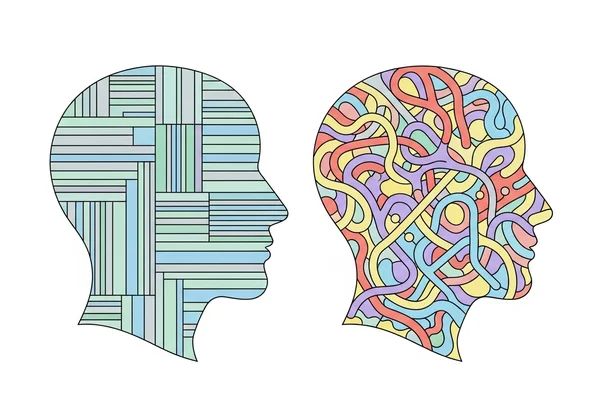
Defining the Spectrum: What Do These Terms Actually Mean
Before we dive into the traits, we need to clear up the terminology. The language around neurodiversity has evolved rapidly, and it is easy to get confused.
The Neurotypical Experience: How the "Majority" Brain Works
Being "neurotypical" (often abbreviated as NT) means that your brain functions and processes information in the way society generally expects. A neurotypical person usually finds it easier to adhere to social norms, handle sensory input without becoming overwhelmed, and transition between tasks.
Think of it as having a brain that is "compatible" with the standard societal infrastructure. The school systems, office environments, and social rules were largely designed by and for neurotypical minds.
The Neurodivergent Experience: Thinking Outside the Box
"Neurodivergent" (ND) simply means having a brain that functions in ways that diverge significantly from the dominant societal standards. This is not a medical defect. It is a difference in how you learn, think, process senses, and communicate.
Neurodivergent people often feel like they are constantly translating a foreign language. The effort required to "fit in" can lead to significant fatigue. However, this divergence also comes with unique perspectives and capabilities that we will discuss later.
Terminology Check: Neurodivergent vs Neurodiverse vs Neurotypical
These terms are often used interchangeably, but there is a grammatical difference:
- Neurodivergent: Describes an individual (e.g., "I am neurodivergent").
- Neurotypical: Describes an individual whose processing matches common expectations.
- Neurodiverse: Describes a group of people with different brain types (e.g., "Our workplace is neurodiverse").
Note: An individual cannot be "neurodiverse" any more than an individual can be "diverse."
Side-by-Side Comparison: Traits & Daily Life
When analyzing neurotypical vs neurodivergent traits, the differences usually show up most clearly in three areas: communication, sensory processing, and focus.
Communication Styles: Direct vs. Indirect (And The "Double Empathy Problem")
This is often the biggest source of friction in relationships and workplaces.
- Neurotypical Communication: Tends to rely heavily on subtext, tone, and implied meaning. "Reading between the lines" is a standard expectation. Small talk is used as a social lubricant to build safety before getting to the point.
- Neurodivergent Communication: Often prefers direct, literal communication. Information is shared for the sake of information (often called "infodumping"). Small talk can feel painful, performative, or pointless.
The Double Empathy Problem: Research suggests that neurodivergent people communicate just fine with other neurodivergent people. The breakdown only happens when ND and NT styles clash. It is a two-way street of misunderstanding, not a deficit on one side.
Scenario Spotlight: How Reactions Differ in Real Life
To make this concrete, let's look at how a neurotypical vs neurodivergent person might react to the same scenario.
Scenario: A vaguely worded email from a boss saying, "We need to talk."
- The Neurotypical Reaction: Might feel a brief worry but will likely scan the context of the week. They might casually ask a colleague if something is up. They assume if it were a disaster, the tone would be different.
- The Neurodivergent Reaction: May experience an immediate "Rejection Sensitive Dysphoria" (RSD) spike. The brain might catastrophize, assuming they are being fired. They might spend hours analyzing every interaction from the past month to find the error.
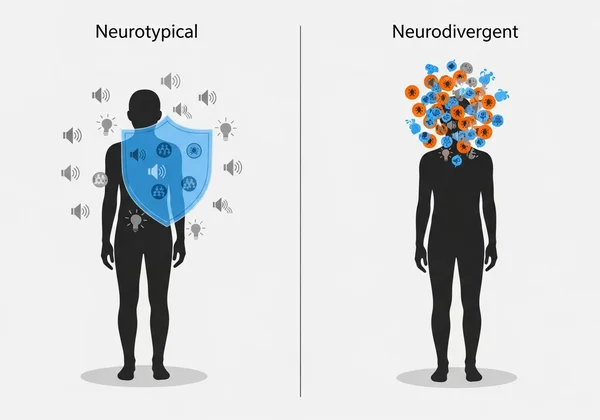
Sensory Processing: Filtering Noise vs. Absorbing Everything
The neurotypical brain is excellent at "synaptic pruning." It filters out background noise—the hum of the fridge, the tag on a shirt, the flickering light—so the person can focus.
In contrast, the neurodivergent brain often lacks this automatic filter. It processes everything with equal intensity.
-
Hypersensitivity: Sounds are louder, lights are brighter, and textures can be physically painful.
-
Hyposensitivity: Seeking strong sensory input, like loud music, weighted blankets, or spicy food, to feel regulated.
Focus & Energy: Linear Attention vs. Hyperfocus Flow
Neurotypical attention is generally interest-based but regulated by importance. They can force themselves to do a boring task because "it needs to be done."
For a neurodivergent person, attention is often purely interest-based.
- The Struggle: Doing a mundane task can feel physically impossible (Executive Dysfunction), not because of laziness, but because the brain chemistry won't engage.
- The Superpower: When interested, they enter "Hyperfocus"—a state of intense, prolonged concentration where they can work for hours without noticing time passing.
The Biological Perspective: Is It Different Wiring
The debate of neurotypical vs neurodivergent isn't just about behavior; it is rooted in biology.
Connectivity & Pruning: How Brains Develop Differently
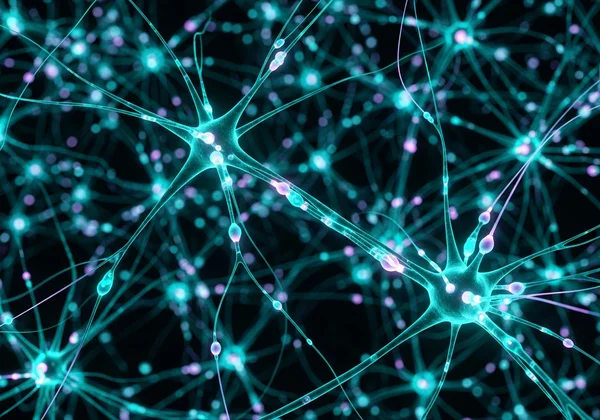
During childhood, the brain undergoes a process called "pruning," where it cuts away neural connections it doesn't use to become more efficient. Research suggests that neurodivergent brains (particularly in Autism and ADHD) may prune less.
This results in a "hyper-connected" brain. While this consumes more energy (leading to faster burnout), it also allows for unique connections between seemingly unrelated concepts.
The Dopamine Factor: Why Motivation Works Differently
This is particularly true for ADHD. The neurotypical brain releases dopamine (the reward chemical) steadily. The ADHD brain often has a dopamine deficiency or efficient transport issue.
This means the neurodivergent brain is constantly hunting for stimulation to reach a baseline that neurotypical people wake up with. This drives the need for novelty, urgency, or passion to get anything done.
Common Examples: What Counts as Neurodivergent
Many people search for neurotypical vs neurodivergent thinking only of one condition, but it is a broad umbrella.
The Big Three: Autism, ADHD, and Dyslexia
- Autism (ASD): Characterized by differences in social communication, sensory processing, and repetitive behaviors or strong interests.
- ADHD: Defined by differences in executive function, attention regulation, and impulse control.
- Dyslexia: Involves differences in language processing, particularly reading and spelling.
Beyond the Basics: Dyspraxia, Tourette’s, and HSP
- Dyspraxia: Affects movement and coordination.
- Tourette’s Syndrome: Involves involuntary tics.
- HSP (Highly Sensitive Person): While not always classified clinically, HSPs share many sensory traits with the neurodivergent community.
If you suspect you might align with one of these profiles, you can **check your traits with this neurodivergent test to gain more clarity.
Signs You Might Be Neurodivergent (And How to Check)
After reading the comparisons above, you might be thinking, "Wait, this sounds exactly like me."
The Value of Self-Reflection
Realizing you might be neurodivergent as an adult can be an emotional rollercoaster. You might feel grief for the years you spent struggling, but also relief that there is a name for your experience. Self-identification is valid and is often the first step toward getting the accommodations you need to thrive.
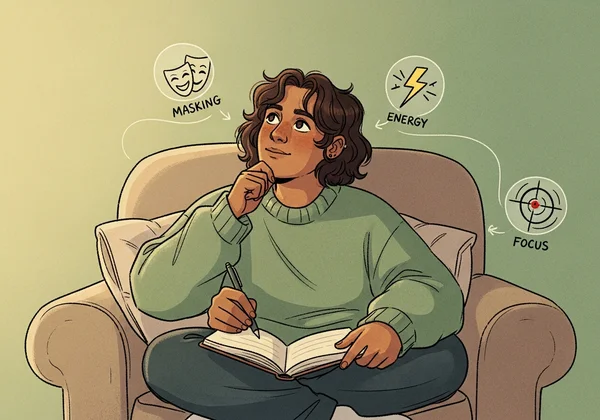
Mini-Checklist: Do These 5 Scenarios Resonate
Before you look for professional confirmation, ask yourself these questions:
- Masking: Do you feel like you have to "perform" or act like a different person in public to be accepted?
- Burnout: Do you get "social hangovers" where you need days of isolation to recover from a social event?
- Special Interests: Do you have topics you love so intensely that you could talk about them for hours, but you struggle to feign interest in small talk?
- Sensory Issues: Do you cut tags off clothes, hate fluorescent lights, or need noise-canceling headphones to think?
- Pattern Recognition: Do you see solutions or patterns at work that others seem to completely miss?
Take the Next Step: Try Our Educational Screening Tool
If you answered "yes" to several of the above, it might be helpful to dig deeper. You don't have to guess.
We have developed a comprehensive, user-friendly tool designed to help you map out your cognitive traits. **Explore your traits with our educational Neurodivergent Test.
Note: This tool is for educational and self-discovery purposes only. It is not a medical diagnosis, but it can provide a detailed report to help you understand yourself or share with a therapist.
Strengths & Challenges: Is It a Disability
The conversation around neurotypical vs neurodivergent often focuses on the struggles, but that is only half the story.
The Social Model: Why "Difference" Can Feel Like "Disability"
Is being left-handed a disability? Only if you are forced to use right-handed scissors.
The "Social Model of Disability" suggests that people are disabled more by the barriers in society than by their bodies or brains. If workplaces offered flexible hours, quiet zones, and direct communication, many "symptoms" of neurodivergence would become less disabling.
The Superpowers: Creativity, Pattern Recognition, and Empathy
When supported, neurodivergent minds offer incredible advantages:
-
Creativity: Thinking outside the box is the default mode.
-
Hyper-empathy: Many neurodivergent people feel others' emotions deeply.
-
Justice Sensitivity: A strong drive to fix unfairness and fight for what is right.
-
Detail Orientation: The ability to spot errors or nuances that slide past the neurotypical filter.

Conclusion: Embracing Your Unique Mind
The journey of understanding neurotypical vs neurodivergent differences is ultimately about self-compassion. Whether your brain follows the standard highway or takes the scenic route, both ways of thinking are necessary for a functioning society.
If you have spent your life feeling like a square peg in a round hole, knowing your "neurotype" can change everything. It allows you to stop fighting your brain and start working with it.
Ready to understand your own mind better? **Start your self-discovery journey with our free assessment today.
Frequently Asked Questions
Can you become neurodivergent later in life?
Generally, neurodivergence is considered innate—you are born with it. However, many people are not identified until adulthood. This often happens when the demands of adult life (work, parenting) exceed their ability to "mask" or compensate, leading to a diagnosis later in life.
How common is neurodivergence?
Estimates vary, but it is believed that 15% to 20% of the world's population exhibits some form of neurodivergence. You are definitely not a "glitch"; you are a significant part of human variation.
Is there a cure for being neurodivergent?
No, and most advocates argue there shouldn't be. Neurodivergence is a way of being, not a disease. The goal is not to "cure" the brain but to accommodate it, support it, and learn to work with your natural rhythms rather than against them.
What should I do if my test results indicate neurodivergence?
If your results resonate with you, the next step depends on your needs. You might seek a formal assessment from a psychologist for legal accommodations, or you might simply use the knowledge to adjust your lifestyle and find community support.
Can I trust online neurodivergent tests?
Online tests vary in quality. They cannot provide a medical diagnosis. However, high-quality, research-backed screeners are excellent for self-discovery and validation. They serve as a starting point for further research or a conversation with a doctor.