Neurotype Meaning: A Plain-English Guide to Neurotypes
If you have seen the word "neurotype" in autism, ADHD, or neurodiversity conversations, you may wonder whether it is a formal label, a personality category, or simply a newer way to talk about the brain. The short answer is this: neurotype meaning refers to a person's general pattern of thinking, sensing, focusing, communicating, and responding to the world. It is a descriptive term, not a medical conclusion. For people who are beginning to notice long-running patterns in attention, sensory needs, social energy, or executive function, a free neurodivergent self-reflection test can be one gentle starting point for organizing observations without treating the result as a final answer.
What Does Neurotype Mean?
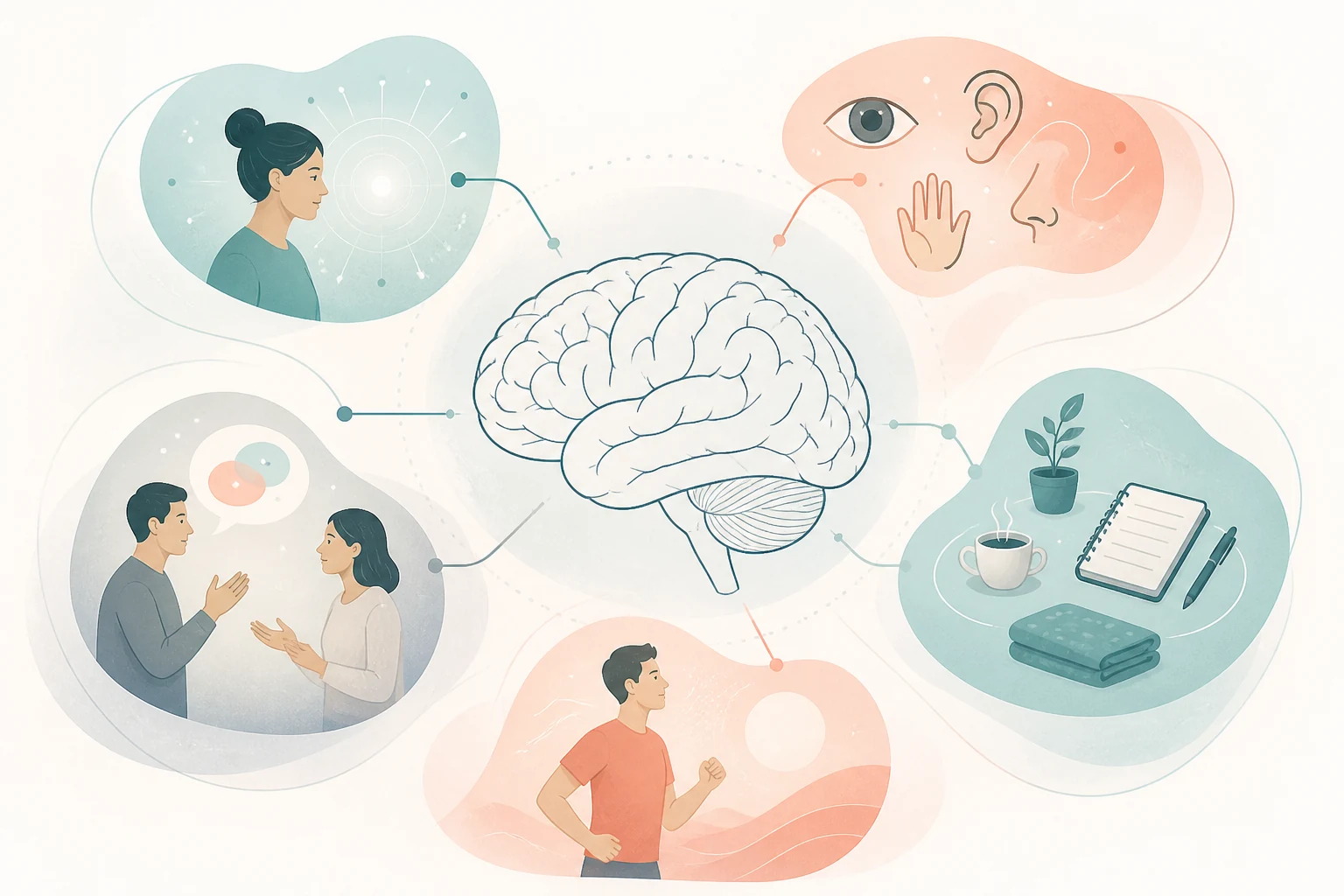
A neurotype is a way to describe the pattern of how someone's nervous system tends to work. It can include how a person takes in sensory information, manages attention, shifts between tasks, reads social context, regulates energy, handles change, or learns best.
The word is most often used in neurodiversity spaces. In that context, it helps people talk about brain differences without ranking one pattern as better, worse, normal, or broken. Someone might say "autistic neurotype," "ADHD neurotype," "neurotypical neurotype," or "my neurotype" when they are trying to describe a recurring pattern in how they experience life.
That does not mean every use of the word has the same level of precision. Sometimes people use neurotype for a formally recognized neurodevelopmental condition. Sometimes they use it more loosely for a profile of traits, needs, and strengths. In everyday writing, the safest interpretation is: a neurotype is a broad pattern, not a complete explanation of a person.
Neurotype, Neurotypical, Neurodivergent, and Neurodiverse
These terms overlap, but they do not mean the same thing.
Neurotype means the specific pattern or profile. It answers the question, "What kind of brain style or nervous-system pattern is being described?"
Neurotypical describes people whose development and everyday cognitive patterns fit what society generally expects from the majority. Neurotypical meaning is not "better" or "more correct." It simply points to a pattern that is more commonly assumed in schools, workplaces, social rules, and many public environments.
Neurodivergent describes a person whose brain or nervous-system patterns differ from those majority expectations. Autism, ADHD, dyslexia, dyspraxia, Tourette syndrome, and other differences may be discussed under this umbrella, depending on context.
Neurodiverse is often used to describe a group, community, classroom, workplace, or population that includes more than one neurotype. One person is usually described as neurodivergent, while a group can be neurodiverse.
Is Autism a Different Neurotype?
Many people do describe autism as a different neurotype. That can be a respectful, strengths-aware way to talk about autistic communication, sensory processing, social energy, routines, focused interests, and need for predictability.
At the same time, autism is also a recognized neurodevelopmental condition with formal evaluation criteria. Calling autism a neurotype does not erase disability, support needs, or the value of professional evaluation. It simply gives people a less pathologizing word for the broad pattern of autistic experience.
The same balance applies to ADHD. Some people speak of an ADHD neurotype because attention, motivation, time sense, emotional regulation, and task initiation may work differently from typical expectations. But the word neurotype should not be used as a shortcut for deciding what someone "has." It is better used as a language tool for noticing patterns and asking better questions.
Why the Word Neurotype Can Be Helpful
The value of "neurotype" is not that it places people into neat boxes. It helps people move from shame to observation.
For example, someone may have spent years thinking, "Why do I overreact to noise?" A neurotype lens can reframe the question as, "What sensory patterns show up for me, and what helps me feel regulated?" Someone who struggles with task switching may move from "I am lazy" to "Transitions seem to require more support for me than for some people."
That shift matters. It can make self-advocacy more practical. Instead of trying to prove an identity in one conversation, a person can collect examples: environments that drain them, routines that stabilize them, communication styles that reduce confusion, and supports that make daily life easier.
This is also where an anonymous self-reflection starting point can be useful. A short educational tool cannot replace a professional conversation, but it can help a person name patterns they may want to explore further.
A Simple Neurotype List Without Turning People Into Categories
Searches like "neurotype list" and "neurotype typology" are common, but lists can be misleading if they imply that each person fits one clean category. Human brains are more complex than that.
Commonly discussed neurotypes or neurodevelopmental differences include autism, ADHD, dyslexia, dyscalculia, dyspraxia, Tourette syndrome, and sensory processing differences. Some people also discuss AuDHD, an informal term for people who relate to both autistic and ADHD patterns.
It is also possible for a person to have overlapping traits, learned coping strategies, trauma responses, cultural differences, anxiety, sleep problems, or stress-related changes that affect how they function. That is why a trait list should be treated as a map, not a verdict.
When reading a neurotype list, ask:
- Which patterns have been present for a long time?
- Which patterns appear across school, work, home, relationships, or daily routines?
- Which patterns create support needs, distress, or practical barriers?
- Which patterns also come with strengths, interests, or ways of learning that feel natural?
- Which explanations would be worth discussing with a qualified professional?

Neurotype Meaning vs Neurotypical Meaning
Because the keyword often appears near "neurotypical meaning," it helps to compare the terms in plain English.
Neurotype is the broader word. Everyone has some kind of neurotype because everyone has a brain and nervous system with patterns. Neurotypical is one possible description of a neurotype, usually meaning that a person's development and functioning align with majority expectations.
Neurotypical behavior may include finding common social rules relatively intuitive, tolerating typical classroom or office sensory environments, shifting attention in ways expected by school or workplace systems, and following routines designed for the majority. But those are broad tendencies, not requirements. A neurotypical person can still feel anxious, dislike noise, need structure, or struggle during hard seasons.
Likewise, a neurodivergent person is not defined only by challenges. Many neurodivergent people describe deep focus, pattern recognition, creativity, strong memory for interests, honesty, persistence, empathy, or original problem-solving. The point is not to romanticize every difficulty. The point is to notice the full profile, including needs and strengths.
Is OCD a Neurotype?
OCD is usually understood as a mental health condition rather than a neurodevelopmental neurotype in the same way autism or ADHD are often discussed. However, real language use can be messy. Some people may include OCD in broader neurodivergent conversations because it involves differences in thoughts, threat perception, uncertainty, routines, and distress.
The most careful answer is: OCD can be part of some neurodivergent discussions, but it should not be casually treated as the same kind of category as autism or ADHD. If intrusive thoughts, compulsions, or anxiety-driven rituals are affecting daily life, educational reflection is not enough by itself. A qualified mental health professional can offer individualized support and evidence-based care.
How to Explore Your Own Neurotype Thoughtfully
If the idea of a neurotype resonates, try slowing the question down. Instead of asking, "Which label fits me?" ask, "What patterns keep showing up?"
Start with daily examples. Write down situations where your attention feels unusually strong or hard to direct, sensory input becomes too much, routines help you function, social interaction takes effort, or emotions change quickly after rejection or criticism. Note what was happening before, what helped, and whether the pattern has appeared for years or mainly during a stressful period.
Then look for context. Many people function differently depending on sleep, workload, hormones, grief, culture, language, masking, or whether the environment supports them. A neurotype lens works best when it includes context instead of reducing everything to one label.
Finally, decide what kind of support you need. Some people only want clearer language for self-understanding. Others want accommodations at school or work. Others want a clinical evaluation because their patterns affect daily care, relationships, employment, or safety. Each path is valid.
Using Neurotype Language With Care
Neurotype language should make people easier to understand, not easier to stereotype. Avoid assuming that every autistic person, every ADHD person, or every neurotypical person behaves the same way. Two people can share a label and still have different sensory profiles, communication styles, strengths, cultures, and support needs.
It is also worth being careful with translations. Searches for neurotypical meaning in Hindi, Urdu, Bengali, Tamil, Tagalog, or Arabic often reflect a real need for accessible language. But direct translations may not carry the same community meaning, especially when local medical, educational, and disability-rights language differs. When possible, pair translated terms with plain examples instead of relying on one word alone.
In conversations, use the language a person uses for themselves. Some people prefer identity-first language such as "autistic person." Others prefer person-first wording or more general language such as "neurodivergent person." Respectful communication begins with listening.
A Gentle Next Step for Understanding Neurotype Meaning
Neurotype meaning is ultimately about patterns: how your brain and nervous system tend to process, respond, focus, connect, and recover. It is not a score, a box, or a promise that one word explains everything.
If you are exploring your own patterns, keep the process curious and practical. Notice what supports you. Notice what drains you. Notice what has been true across time and what may be tied to a temporary season. When you want a low-pressure way to organize those reflections, the gentle neurodivergent test can help you gather language for what you are noticing, while leaving room for professional guidance when you need it.
FAQ
What does neurotype mean in simple terms?
Neurotype means a person's general pattern of brain and nervous-system functioning. It can include attention, sensory processing, communication, learning, routines, social energy, and emotional regulation. It is descriptive language, not a medical conclusion.
What is a person who is neurodiverse?
"Neurodiverse" is best used for groups that include multiple neurotypes. For one person, many writers use "neurodivergent" when that person's patterns differ from typical expectations. In casual speech, people sometimes mix the terms, so context matters.
What is neurotypical behavior?
Neurotypical behavior usually means behavior that fits majority expectations for attention, communication, sensory tolerance, social cues, and routine changes. It does not mean perfect functioning, and it does not make one brain style better than another.
Is autism a neurotype?
Many people describe autism as a neurotype because it involves a distinct pattern of communication, sensory experience, attention, routines, and social processing. Autism is also a formal clinical category, so neurotype language should be used respectfully and carefully.
Is ADHD a neurotype?
ADHD is often discussed as a neurotype because it can involve different patterns of attention, motivation, time awareness, emotional regulation, and executive function. Like autism, ADHD can also be evaluated clinically, so the word neurotype should not be treated as proof by itself.
What is the opposite of neurotypical?
The common opposite is neurodivergent. Neurotypical describes patterns that fit majority expectations, while neurodivergent describes patterns that differ from those expectations. Both terms are broad and should be used with nuance.
How can I tell what my neurotype is?
You can begin by noticing long-running patterns in attention, sensory needs, communication, routines, learning, and energy. A self-reflection tool, journaling, trusted feedback, and professional evaluation can all help, depending on what kind of clarity or support you need.