Neurodiversity Movement History, Timeline, Principles, and Criticism
The neurodiversity movement is a rights-focused and culture-shaping movement that asks society to treat neurological differences as part of human diversity, not as automatic signs of brokenness. It grew from autistic self-advocacy, disability rights, online peer communities, and later advocacy around ADHD, dyslexia, dyspraxia, Tourette syndrome, learning differences, and other neurodivergent experiences. For readers who are still learning the language, a gentle free neurodivergent self-reflection tool can be one educational starting point, but it should never replace a qualified professional evaluation when that kind of support is needed.
This guide explains the neurodiversity movement definition, its history, its timeline, its key principles, common criticism, and how the idea relates to autism and ADHD today.

What Is the Neurodiversity Movement?
The neurodiversity movement is a social and disability rights movement. Its central argument is that differences in how people perceive, communicate, learn, focus, move, regulate emotion, and process sensory information should be understood in context. Some differences create real support needs. Some are strengths in the right environment. Many are both.
That distinction matters. The movement does not say that every neurodivergent person has an easy life, or that support is unnecessary. Instead, it challenges the assumption that the individual must always be changed to fit a narrow norm. It asks schools, workplaces, families, media, and healthcare systems to reduce stigma, improve accessibility, listen to lived experience, and provide support without treating identity as something shameful.
In plain language, advocates of the neurodiversity movement argue that human brains vary, society often disables people through inflexible systems, and people with different neurotypes deserve rights, respect, autonomy, and practical accommodations.
Neurodiversity Movement History and Origins
The history of the neurodiversity movement is closely tied to autistic self-advocacy. In the late twentieth century, autistic adults began building spaces where they could speak for themselves rather than being spoken about only by parents, clinicians, researchers, or charities. Early internet forums and mailing lists were especially important because they allowed people who were geographically isolated to compare experiences, develop language, and organize around shared concerns.
Several names often appear in neurodiversity movement history. Jim Sinclair's early autism rights writing helped shape the idea that autism is part of a person's way of being, not a detachable layer. Online communities such as Autism Network International and Independent Living on the Autistic Spectrum helped autistic people exchange ideas about self-advocacy. Journalist Harvey Blume helped popularize the language in late 1990s media. Sociologist Judy Singer is widely associated with bringing the term neurodiversity into academic and public discussion, though recent scholarship and community accounts emphasize that the concept developed collectively through many autistic and neurodivergent voices.
The term neurodivergent came later and is often credited to Kassiane Asasumasu, who used it to include people whose neurocognitive functioning diverges from dominant norms in many ways. That broader wording helped the conversation expand beyond autism alone.
Neurodiversity Movement Timeline
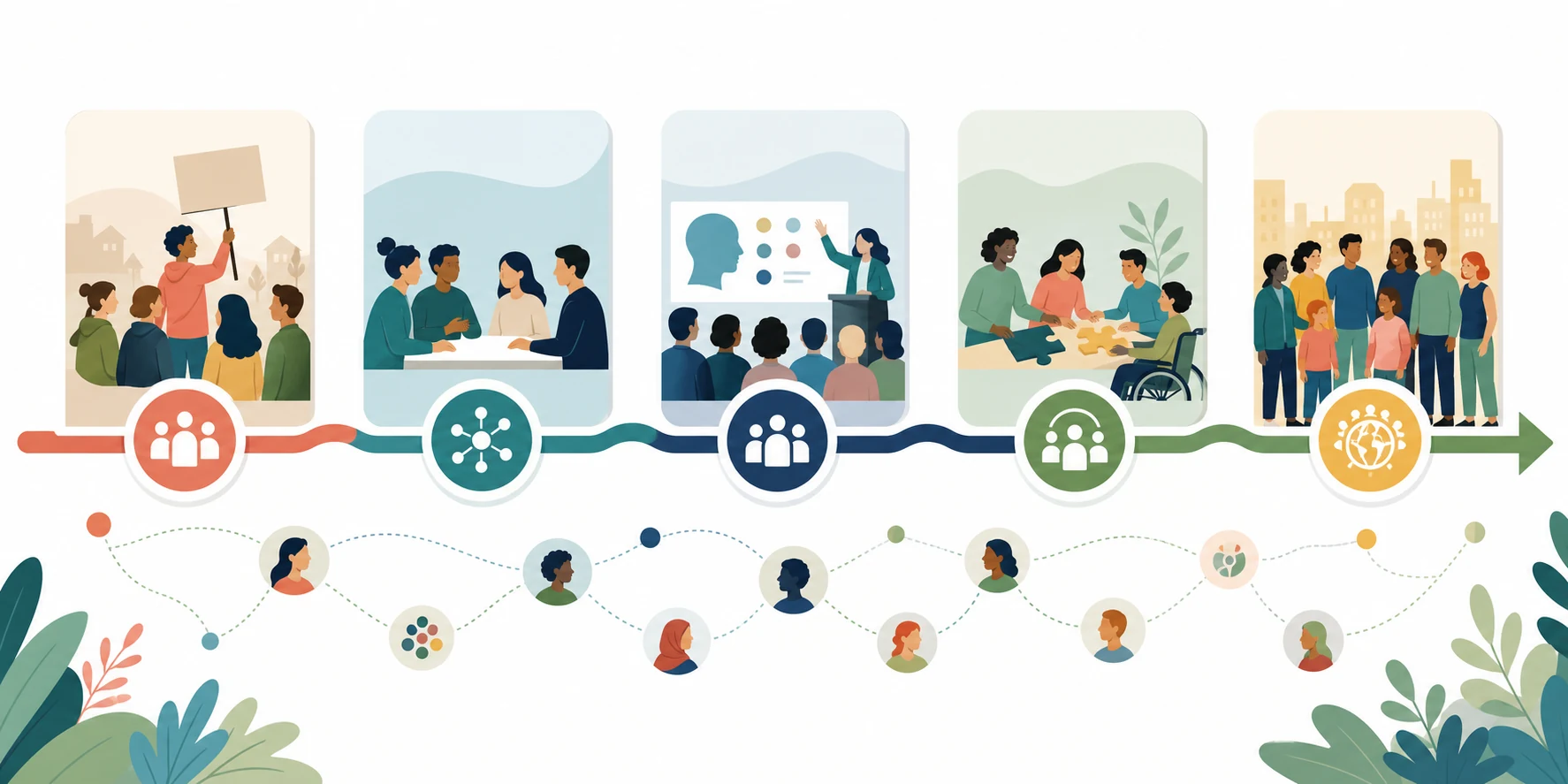
A simple neurodiversity movement timeline helps show how the idea moved from peer conversation to public language:
- 1970s and 1980s: Disability rights and psychiatric survivor movements challenge institutions, forced treatment, exclusion, and the idea that professionals should control every conversation about disabled people.
- Early 1990s: Autistic-led groups and writing make self-advocacy more visible.
- 1993: Jim Sinclair's writing becomes an influential statement in autism rights discussions.
- Mid-1990s: Online autistic communities grow through mailing lists, forums, and early web spaces.
- 1997 to 1999: The language of neurodiversity enters journalism, academic work, and public conversation.
- Around 2000: Neurodivergent and neurodivergence become useful umbrella terms for wider community language.
- 2000s and 2010s: Neurodiversity-affirming education, workplace inclusion, autism rights advocacy, and ADHD-focused discussions become more visible.
- 2020s: The movement becomes mainstream enough to influence schools, hiring, therapy language, media representation, and self-understanding, while also facing stronger public debate about limits, evidence, and support needs.
Three Core Principles of the Neurodiversity Movement
People describe the movement in different ways, but three practical pillars appear again and again.
1. Difference Is Not Automatically Defect
The movement rejects the idea that one typical brain style is the only correct way to think, learn, communicate, or participate. A person may need support and still have a valid identity. A child who communicates differently, an adult with ADHD who needs external structure, or an autistic person with sensory sensitivities should not be treated as less worthy because their needs are visible.
This is not the same as pretending challenges do not exist. It means that support should focus on access, communication, safety, autonomy, and quality of life rather than shame.
2. Lived Experience Should Shape Decisions
The phrase "nothing about us without us" is often associated with disability rights, and it fits the neurodiversity movement well. Policies, therapies, school plans, workplace supports, and public campaigns are stronger when neurodivergent people are involved in designing them.
This principle also changes how people interpret behavior. Instead of asking only how to stop a visible behavior, a neurodiversity-affirming approach asks what the behavior may be communicating, what sensory or social demands are present, and what support would preserve dignity.
3. Support and Acceptance Can Coexist
One common misunderstanding is that the movement opposes help. A more accurate version is this: help should not require a person to reject who they are. Someone may benefit from medication, coaching, assistive technology, communication support, therapy, classroom changes, or workplace accommodations while still seeing their neurotype as part of their identity.
This middle path matters for ADHD and autism in particular. ADHD can involve real difficulties with time, attention, emotional regulation, and task initiation. Autism can involve communication differences, sensory intensity, routine needs, and uneven support needs. The movement asks society to address those realities without reducing people to deficits.
Neurodiversity Movement Autism and ADHD Connections
Autism remains central to the neurodiversity movement because autistic self-advocacy helped create much of the language. Many autistic advocates pushed back against public messaging that framed autism only through burden, tragedy, or fear. They called for acceptance, communication access, sensory-friendly spaces, and respect for autistic adulthood.
ADHD discussions have also grown within the movement. For many people with ADHD, neurodiversity language offers a way to understand executive function differences without collapsing into self-blame. It can help a person ask, "What environment helps my attention work better?" rather than only, "Why can't I force myself to function like everyone else?"
At the same time, autism and ADHD are not identical. Neurodiversity-affirming support should be specific. Sensory supports, communication preferences, stimulant medication decisions, sleep routines, classroom accommodations, and workplace tools all require different conversations. Readers exploring their own patterns can use a neurodivergent trait self-check as a reflective prompt, then bring patterns and questions to an appropriate professional if they want deeper support.

Neurodiversity Movement Criticism and Fair Concerns
Critiques of the neurodiversity movement are important to understand because they often point to real tensions. Some families worry that public language about acceptance may overlook people with high support needs. Some clinicians worry that social media oversimplifies complex conditions. Some neurodivergent people dislike being used as workplace branding while still lacking real accommodations. Others object when the movement is presented as if all neurodivergent experiences are the same.
The strongest response is not to dismiss every concern. A mature version of the movement should make room for people who communicate through AAC, people with intellectual disability, people who need daily care, people with co-occurring mental health needs, and people who want practical symptom support. It should also be careful about evidence, especially when discussing therapy, medication, education, or workplace policy.
There is also a difference between criticism of the movement and criticism of shallow versions of the movement. A poster about "thinking differently" is not enough if a school still punishes sensory overload. A hiring campaign is not enough if interviews remain inaccessible. A supportive hashtag is not enough if people are denied communication tools, rest, privacy, or autonomy.
What the Neurodiversity Movement Means in Everyday Life
The movement becomes useful when it changes ordinary decisions. In schools, it can mean flexible seating, predictable routines, multiple ways to show learning, sensory-aware classrooms, and respectful communication. In workplaces, it can mean clear written expectations, quiet spaces, flexible scheduling where possible, interview changes, and managers who do not confuse difference with lack of motivation.
In families, it can mean replacing blame with curiosity. A child who melts down after a noisy day may need decompression, not a moral lecture. An adult who misses deadlines may need external planning supports, not character judgment. A partner who communicates directly may need shared expectations, not constant masking.
For individuals, the movement can be a language of self-understanding. It can help people separate "I am failing" from "this environment is not built for my nervous system." That shift does not solve everything, but it can open the door to better questions: What drains me? What helps me think clearly? What accommodations would reduce friction? What support is worth seeking?
How to Use the Idea Responsibly
The neurodiversity movement is most helpful when it stays both affirming and honest. Use it to reduce shame, but not to avoid support. Use it to ask for accessibility, but not to assume every neurodivergent person wants the same language. Use it to question stigma, but not to make medical, educational, or workplace decisions from internet summaries alone.
If you are exploring whether your own traits may fit a neurodivergent pattern, keep notes on concrete experiences: attention, sensory processing, communication, transitions, routines, learning history, emotional regulation, and burnout. An optional gentle neurodivergent test can help organize reflection, especially if you want language for a later conversation with a trusted professional, educator, coach, or support person.
The best version of the neurodiversity movement does not flatten difference into a slogan. It makes more room: room for pride, room for support, room for high needs, room for autonomy, room for disagreement, and room for people to be understood without being reduced to a label.

FAQ
What is the neurodiversity movement definition?
The neurodiversity movement is a rights and inclusion movement that views neurological differences as part of human diversity. It advocates respect, accessibility, autonomy, and support for neurodivergent people instead of stigma or forced conformity.
When did the neurodiversity movement start?
Its roots are in disability rights and autistic self-advocacy, especially from the late 1980s through the 1990s. The term neurodiversity became more visible in the late 1990s through online autistic communities, journalism, and academic writing.
Is the neurodiversity movement only about autism?
No. Autism played a major role in the movement's origins, but the wider movement includes many neurodivergent experiences, including ADHD, dyslexia, dyspraxia, Tourette syndrome, learning differences, and other ways of diverging from dominant cognitive norms.
Does the neurodiversity movement reject support?
Not in its strongest form. It argues that support should be respectful, consensual, evidence-aware, and focused on access and quality of life. Acceptance and support can exist together.
What is common criticism of the neurodiversity movement?
Common criticism includes concern that high support needs may be overlooked, that social media may oversimplify complex experiences, and that institutions may use inclusive language without providing real accommodations.
What does neurodiversity-affirming mean?
Neurodiversity-affirming usually means respecting a person's neurotype while still offering practical support. It emphasizes dignity, autonomy, communication access, sensory needs, strengths, and accommodations rather than shame or forced masking.