Mental Divergence: What It Means, Why It Matters, and How to Understand a Divergent Mind
If you have come across the term "mental divergence" and wondered what it means, you are not alone. Whether you heard it in a conversation, read it online, or even recognized it from a movie quote, the phrase taps into one of the most important conversations happening in psychology today: neurodivergence — the idea that not all brains work the same way, and that is not only okay, it is valuable. This guide explains what mental divergence actually refers to, what types of neurodivergence exist, how to recognize the signs, and what to do if you think you or someone you know might be neurodivergent. If you are looking for a private starting point to explore your own neurological profile, a free neurodivergent screening can help you reflect on your unique patterns.
What Does "Mental Divergence" Mean?
"Mental divergence" is not a formal clinical term, but it is a widely understood phrase that describes the same concept as neurodivergence — a brain that functions, develops, or processes information differently from what society considers "typical" or "normal."
The more precise term used in psychology and neuroscience is neurodivergent. A person is neurodivergent when their brain works in ways that differ significantly from the dominant societal standards of "normal." This includes differences in how they think, learn, focus, communicate, and experience the world.
Key points to understand:
- Neurodivergence is not a diagnosis. It is an umbrella term that encompasses many specific conditions and variations.
- It is not a mental illness. While neurodivergent people may experience mental health challenges, the divergence itself is a natural variation in human brain wiring — not a disease.
- It is not a deficit. The neurodiversity framework emphasizes that different brain types come with unique strengths alongside challenges.
- It can be innate or acquired. Some people are born neurodivergent; others may develop neurological differences after brain injury, chronic illness, or other life events.
When someone says "mental divergence," they are describing the experience of having a mind that works differently from what most people expect. And that experience is far more common than many realize.
Types of Neurodivergence: What Falls Under the Umbrella?
Neurodivergence is a broad category that includes many different conditions and neurological variations. Here are the most commonly recognized types.
Autism Spectrum Disorder (ASD)
Autism involves differences in social communication, sensory processing, and patterns of behavior and interest. Autistic individuals may experience the world more intensely, think in highly detailed or systematic ways, and communicate differently from neurotypical norms. Autism is a spectrum — meaning it manifests very differently from person to person.
Attention-Deficit/Hyperactivity Disorder (ADHD)
ADHD is characterized by differences in attention regulation, impulse control, and activity levels. Contrary to the name, people with ADHD often have an abundance of attention — but struggle to direct it consistently. They may experience intense focus (hyperfocus) on preferred topics while finding mundane tasks nearly impossible.
Dyslexia
Dyslexia affects reading and language processing. People with dyslexia may struggle with decoding words, spelling, and reading fluency, but often excel in creative thinking, problem-solving, and big-picture reasoning.
Dyscalculia
Dyscalculia affects numerical processing and mathematical reasoning. People with dyscalculia may struggle with basic arithmetic, telling time, estimating quantities, and managing money — despite having strong abilities in other areas.
Dyspraxia (Developmental Coordination Disorder)
Dyspraxia affects motor coordination and planning. It can make tasks like handwriting, tying shoes, and navigating physical spaces more challenging.
Tourette Syndrome
Tourette syndrome involves involuntary movements and vocalizations called tics. It is a neurological condition, not a behavioral one, and varies widely in severity.
Other Forms of Neurodivergence
The umbrella also encompasses sensory processing disorders, intellectual disabilities, giftedness, and — depending on the framework — conditions like OCD, bipolar disorder, and chronic anxiety that significantly alter how the brain functions.
Signs You or Someone You Know Might Be Mentally Divergent
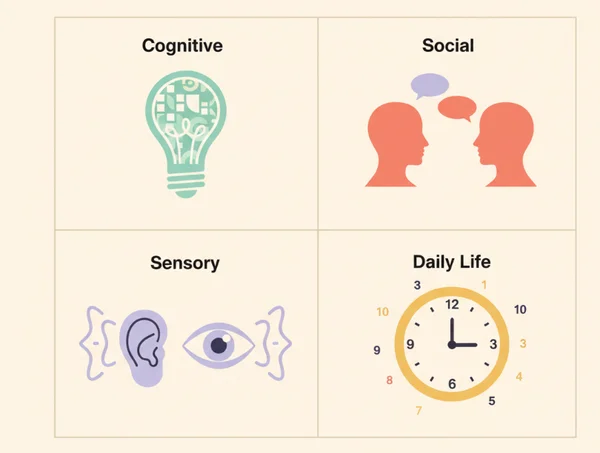
Neurodivergence shows up differently in every person, but there are patterns that many neurodivergent individuals recognize. Here are some common signs across categories.
Cognitive and Learning Patterns
- Different learning styles: You learn best through unconventional methods — perhaps visually, through hands-on activity, or through intense deep dives into topics of interest
- Difficulty with "simple" tasks: Tasks that seem easy to others (time management, following multi-step instructions, organizing) require enormous effort
- Hyperfocus: You can concentrate intensely on things that interest you for hours — sometimes losing track of time entirely
- Pattern recognition: You notice details, connections, and patterns that others miss
Social and Communication Patterns
- Feeling "different": A persistent sense of not fitting in, even when you cannot pinpoint why
- Masking: Consciously adjusting your behavior, speech, or reactions to match social expectations — which is exhausting
- Literal interpretation: Taking things at face value, missing sarcasm, or struggling to read between the lines
- Deep empathy: Many neurodivergent people feel emotions very intensely — for themselves and for others
Sensory and Emotional Patterns
- Sensory sensitivity: Strong reactions to lights, sounds, textures, smells, or temperatures that others barely notice
- Emotional intensity: Feeling things more deeply, recovering from emotional setbacks more slowly, or experiencing rejection with physical pain
- Need for routine: Finding comfort in predictable patterns and feeling distressed when routines are disrupted
- Stimming: Repetitive movements or behaviors (tapping, rocking, fidgeting) that help with self-regulation
In Daily Life
- Chronic lateness or time blindness: Genuinely struggling to gauge how long things take
- Burnout cycles: Periods of intense productivity followed by crashes — often misread as laziness
- Executive dysfunction: Knowing what you need to do but being physically unable to start
If several of these resonate strongly with you, it does not mean something is "wrong." It may mean your brain works differently — and understanding that difference can be transformative.
Mental Divergence vs. Mental Illness: What Is the Difference?
This is one of the most important distinctions to understand. While the terms sound similar, they describe fundamentally different things.
| Mental Divergence (Neurodivergence) | Mental Illness | |
|---|---|---|
| What it is | A natural variation in brain wiring and functioning | A health condition that affects mood, thinking, or behavior |
| Is it a disorder? | Not inherently — it is a difference | Yes — it is a diagnosable condition that causes distress |
| Can it be "cured"? | No — and it does not need to be | Many can be treated and managed effectively |
| Examples | Autism, ADHD, dyslexia, dyscalculia | Depression, generalized anxiety disorder, schizophrenia |
| Stigma | Often misunderstood as deficiency | Often misunderstood as weakness |
Important nuances:
- Neurodivergent people can also experience mental illness — and often do, partly because navigating a world not built for their brain type creates chronic stress
- Some conditions (like OCD or bipolar disorder) sit in a gray area — they are clinical diagnoses, but some advocates include them under the neurodivergent umbrella
- The line between "divergence" and "disorder" can depend on context: the same trait might be a strength in one environment and a significant challenge in another
The "12 Monkeys" Connection: Mentally Divergent in Pop Culture
If you arrived here searching for "12 Monkeys mentally divergent," you are likely referencing the science fiction film and TV series where the term is used to describe those who think differently from the societal norm — outsiders, nonconformists, and visionaries who see patterns the majority cannot.
While the fictional use of "mentally divergent" is dramatic, it does touch on a real truth: people who think differently have always been the ones who see what others miss. Throughout history, divergent thinkers have been responsible for breakthroughs in science, art, technology, and social change.
The neurodiversity movement embraces this idea — not to romanticize struggle, but to acknowledge that cognitive differences are a source of innovation and perspective that the world needs.
What to Do If You Think You Are Neurodivergent
If this article has helped you connect dots about your own experience, here are practical next steps.
1. Start With Self-Reflection
Before pursuing a formal diagnosis, spend time reflecting on your patterns. Which signs from this article resonate most? How do they show up in your daily life? An online neurodivergent screening can provide a structured, private way to explore these questions — and help you identify which areas to discuss with a professional.
2. Educate Yourself
Read first-person accounts from neurodivergent people. Communities on Reddit (r/neurodiversity, r/ADHD, r/autism), TikTok, and YouTube are rich with lived experience that can help you feel less alone. Books like Divergent Mind by Jenara Nerenberg and Unmasking Autism by Devon Price offer deeply researched perspectives.
3. Consider Professional Evaluation
If your experiences are significantly affecting your daily functioning, a formal assessment can provide clarity and access to support. Evaluations are typically conducted by:
- Clinical psychologists or neuropsychologists — for comprehensive assessment
- Psychiatrists — especially if medication may be relevant (e.g., for ADHD)
- Educational psychologists — particularly for learning-related conditions like dyslexia
4. Build Your Support System
Whether or not you pursue a diagnosis, connecting with others who share your experience is powerful. Look for:
- Local or online neurodiversity support groups
- Workplace neurodiversity programs (increasingly common in progressive organizations)
- Therapists who specialize in neurodivergent clients — not all therapists understand these differences
5. Embrace Your Strengths
Neurodivergence is not just about challenges. Many neurodivergent people bring extraordinary creativity, pattern recognition, empathy, persistence, innovative thinking, and deep expertise in their areas of interest. Understanding your neurological profile helps you leverage these strengths intentionally.
Your Brain Is Not Broken — It Is Different
Whether you call it mental divergence, neurodivergence, or simply thinking differently, the core message is the same: there is no single "right" way for a human brain to work. The challenges are real — but so are the strengths. And the first step toward a better life is understanding how your mind actually operates, rather than forcing it to conform to someone else's blueprint.
This content is for educational purposes only. It is not a clinical diagnosis or substitute for professional evaluation. If you suspect you may be neurodivergent and it is affecting your daily life, please consult a qualified healthcare professional.
Ready to start exploring? Take the free neurodivergent screening at NeurodivergentTest.org — it takes just a few minutes and your results are completely private.
Frequently Asked Questions
What does "mentally divergent" mean?
"Mentally divergent" describes a person whose brain functions, develops, or processes information differently from what is considered typical. It is closely related to the formal term "neurodivergent," which encompasses conditions like autism, ADHD, dyslexia, and others. It is not a clinical diagnosis but an umbrella concept recognizing natural brain diversity.
Is mental divergence the same as mental illness?
No. Mental divergence (neurodivergence) refers to natural variations in brain wiring — differences in how a person thinks, learns, and processes information. Mental illness refers to diagnosable health conditions that cause significant distress. A neurodivergent person may also experience mental illness, but the divergence itself is not a disorder.
What are the most common types of neurodivergence?
The most commonly recognized types include autism spectrum disorder (ASD), attention-deficit/hyperactivity disorder (ADHD), dyslexia, dyscalculia, dyspraxia, and Tourette syndrome. Some frameworks also include conditions like OCD, bipolar disorder, and sensory processing disorders.
How do I know if I am neurodivergent?
Common signs include feeling persistently "different" from peers, difficulty with tasks others find easy (or excelling at tasks others find hard), sensory sensitivities, intense emotions, hyperfocus, executive dysfunction, and a need for routine. A professional evaluation by a psychologist or neuropsychologist can provide a formal assessment.
Can you become neurodivergent later in life?
Some forms of neurodivergence are present from birth (like autism or dyslexia), while others can be acquired through brain injury, chronic illness, or other neurological events. Additionally, many people are neurodivergent their entire lives but only recognize it in adulthood.
What does "mentally divergent" mean in 12 Monkeys?
In the film and TV series 12 Monkeys, "mentally divergent" is used to describe individuals who think differently from societal norms — outsiders who perceive reality in unconventional ways. While fictional, the term mirrors the real concept of neurodivergence: the idea that different ways of thinking are not inherently dysfunctional.
Is neurodivergence a disability?
This depends on context and perspective. Many neurodivergent people experience real challenges that can be disabling, especially in environments not designed for their needs. However, the neurodiversity movement emphasizes that divergence is a natural variation rather than an inherent defect — and that much of the "disability" comes from societal structures rather than the brain difference itself.